An AI Center of Excellence (CoE) is a centralised organisational unit that establishes standards, shares best practices, and coordinates AI initiatives across business functions to prevent duplication and accelerate adoption. According to Gartner, organisations with a mature AI CoE bring AI projects to production 2.5x faster and reduce redundant spending by 30%. But the CoE is also where AI ambitions go to die when it is structured wrong — becoming a gatekeeper, a bottleneck, or a technology club detached from business outcomes. This guide covers CoE structure, staffing models, governance frameworks, and the common failure patterns that turn accelerators into bottlenecks.
The Hub-and-Spoke Model
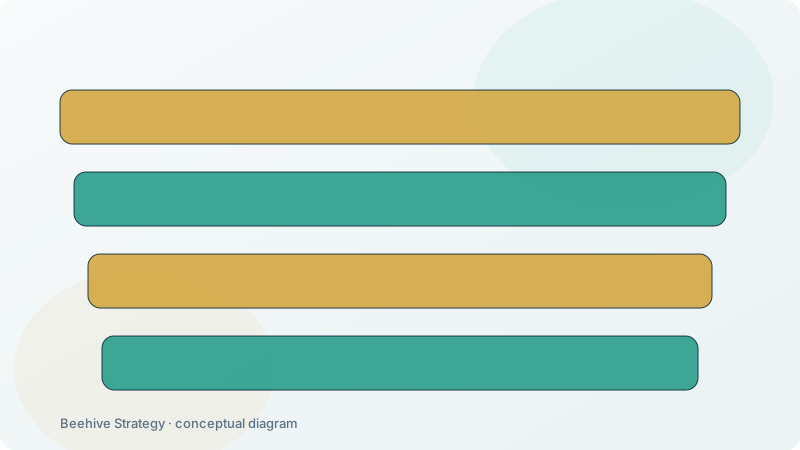
The most effective CoE structure is hub-and-spoke. A central team — the hub — maintains platform infrastructure, governance frameworks, standards, and best practices. Embedded AI specialists — the spokes — sit inside each business unit and work on domain-specific use cases with the people who own the problems. The hub enables; the spokes execute. This division of labour is what makes the 2.5x acceleration possible: the hub prevents every team from rebuilding the same governance and plumbing, while the spokes keep the work close to the business.
The model works because it resolves the centralisation paradox that kills most AI initiatives. Fully centralised AI — one team building everything — scales governance well but bottlenecks execution, because the central team cannot know every business domain deeply. Fully decentralised AI — every team doing its own thing — scales execution but fragments standards, creating a dozen incompatible platforms and ungoverned data access. Hub-and-spoke keeps the standards central and the execution local, which is the only configuration where both scale simultaneously.
The spokes are the part most organisations underinvest in. A spoke is not a liaison who forwards requests; it is an embedded specialist with real authority over the business unit's AI roadmap, reporting jointly to the hub and the unit. When spokes are merely messengers, the model degrades into a central queue with extra travel time.
A useful way to size the hub is to treat it as a platform product team rather than a project team. The hub's backlog should be ranked by how many downstream teams each item unblocks: a shared feature store that serves ten business units outranks a bespoke model that serves one. Organisations that manage the hub with product metrics — adoption, time saved, incidents prevented — instead of activity metrics keep it oriented toward leverage rather than output.
In practice the right ratio shifts with maturity. Early on, when standards and the platform barely exist, the hub may be relatively large because it is building the foundations everyone will reuse. As those foundations harden into self-service, the hub should shrink toward a small centre of expertise while the spoke count grows with each new business unit that adopts AI. Freezing the ratio at the starting point is a common mistake: a hub sized for year-one foundation-building becomes dead weight by year three if it is never allowed to contract.
The reporting structure should mirror the logic. Spokes report jointly to the hub, for standards and career, and to the business unit, for priorities, and that dual line is deliberately uncomfortable — it is what stops a spoke from drifting into pure delivery or pure advocacy. When the line collapses to one side the model breaks: report only to the business and the spoke becomes just another delivery resource; report only to the hub and it loses touch with the problem it exists to solve.
The hub also needs a doctrine, not just a backlog. The single most useful document a new CoE can publish is a short "what we will and will not build" note: we will build the shared platform and the guardrails; we will not build your one-off model; we will teach you to build it. Teams that know the boundary stop asking the centre to do their work, and the centre stops drifting into delivery — which is exactly where most CoEs quietly die.
Key Roles in the CoE
A functioning CoE needs five roles, and each maps to a specific failure mode it prevents:
- Head of AI — sets strategy, prioritises initiatives, and owns the AI roadmap's alignment with business goals.
- Platform Engineer — builds and maintains the shared AI infrastructure, so teams do not each stand up their own stacks.
- MLOps Engineer — owns deployment pipelines, monitoring, and model lifecycle management, so models do not rot in notebooks.
- AI Ethics and Governance Lead — ensures compliance, responsible AI practices, and auditability, so innovation does not outrun control.
- Business Partners — embedded in each business unit to identify, prioritise, and champion use cases from the inside.
The staffing pattern matters as much as the roles. The hub should stay deliberately small relative to the organisation — its job is leverage, not volume — while the spokes scale with the number of business units. Skill composition also matters: a CoE staffed entirely with ML researchers will produce impressive models and failed deployments. The skills that predict success are platform engineering, change management, and business fluency — the disciplines that take a model the last mile to a decision someone actually makes.
Hiring for the CoE is less about finding the best individual modellers and more about assembling a balanced bench. A strong hub pairs one or two deep platform engineers with a governance lead who can translate regulation into guardrails, and a business partner who can sit in a P&L meeting and return with a scoped use case. Where an organisation cannot hire all five roles at once, sequence them: stand up the platform engineer and the governance lead first, because they create the safe rails that let everything else scale; specialist modellers can be sourced per project once the rails exist.
Retention is the quiet risk. CoE talent is precisely the talent the broader market is bidding up, and a centre that becomes a training ground feeding other teams is healthy only if its core stays stable. The organisations that keep capability pair interesting work with a clear internal career ladder — "AI platform engineer" should map to a recognisable progression, not a dead-end staff role — and they rotate business partners back through the hub so domain knowledge compounds instead of leaking away.
The governance lead in particular is often the role executives undervalue, because it produces no model. Yet it is the role that determines whether the organisation can defend its AI in front of a regulator, an auditor, or a customer who asks how a decision about them was made. A CoE without a credible governance lead is a CoE one incident away from being shut down; one with a strong lead can take risks the business would otherwise forbid.
One role deserves more emphasis than it usually gets: the business partner. This is not a translator between "the AI people" and "the business people"; it is someone fluent in both, who can refuse a bad use case as credibly as they champion a good one. CoEs that staff this role weakly — assigning a junior analyst to "collect requirements" — discover too late that the hub built the wrong thing well. The business partner is the immune system of the model, and it should be senior.
None of this requires hiring from the frontier labs. The centre's hardest-to-find skill is the platform engineer who has shipped production ML systems and hates toil — that person turns governance from a slide into a control plane. Everything else can be grown internally once that foundation exists.
What the CoE Should NOT Do
The CoE should not be the only team that builds AI. If every AI project requires the CoE's direct involvement, you have created a bottleneck wearing the costume of an accelerator. The CoE's job is to enable other teams to build AI safely and efficiently — to make the second, third, and tenth AI project cheaper than the first by providing the platform, the standards, and the training that make independent delivery possible.
This is the most common misunderstanding of the CoE concept, and it is why so many CoEs are measured by the wrong metric. The success measure is not how many projects the CoE delivers; it is how many teams can deploy AI independently because of what the CoE built. A CoE that delivers fifty projects but leaves every other team dependent on it has failed at the actual objective; a CoE that delivers ten projects and makes forty teams self-sufficient has succeeded wildly.
The enabling posture has concrete implications. Standards must be published, not guarded — compliance checks automated, not approval-gated; platforms offered as self-service, not as ticket queues. The CoE's governance value is highest when it is invisible: when teams follow good practice because the platform makes it the easy path, not because a committee reviewed their plan.
The funding model reinforces the posture. When the CoE is funded as a cost centre whose budget is justified by the projects it delivers, it is structurally pushed to hoard work. When it is funded as a platform whose success is measured by others' independent deployments, it is pushed to give work away. Several mature organisations formalise this by charging business units only for the shared platform, never for the CoE's enablement help, so the incentives line up with the actual objective: a workforce that can ship AI without calling the centre.
Worth stating plainly: enabling does not mean absent. A CoE that disappears into a wiki of best-practice documents has failed as surely as one that bottlenecks every request. The difference is whether the platform does the enforcing — good practice is the default path because the tooling makes it easier than the bad path — rather than a set of guidelines someone must choose to follow. Enablement is engineered, not advised.
A telling sign of the wrong funding model is the ticket queue. When business units must open a ticket and wait for the CoE to build their model, the centre is implicitly paid to stay busy, and every efficiency that lets a team self-serve shrinks its perceived value. The funded-as-platform CoE inverts this: each team that leaves the queue is a win, and the centre's budget grows with the organisation's capability, not with its own labour.
How Do You Know Your CoE Is Working?
The honest test of a CoE is not activity; it is outcomes that survive scrutiny. The metrics that actually indicate health are: the number of business units deploying AI independently; the time from approved use case to production; the reuse rate of platform assets and models; the volume of shadow AI (unmanaged tools and unsanctioned models) — which should fall, not rise; and the share of AI spend that is redundant or duplicated.
Track these as a small dashboard, reviewed quarterly, with the CoE's mandate attached to the numbers:
- Independent deployments — how many teams shipped AI without CoE involvement?
- Time to production — from approved use case to live value, trending down.
- Asset reuse — how many projects consume shared infrastructure, models, or data products?
- Shadow AI — the volume of ungoverned AI activity, which is the inverse of CoE health.
Beware the vanity metrics. 'Projects delivered' measures the CoE's own output, not the organisation's capability. 'Model accuracy' measures the lab, not the decision. A CoE that reports impressive project counts while the organisation's AI activity fragments into shadow tools is failing in exactly the way its structure was meant to prevent.
The review cadence is what turns these metrics into behaviour. A quarterly dashboard that nobody acts on is theatre; a monthly check where the CoE lead answers "which teams shipped without us, and why did the ones that didn't stall" creates accountability. The most informative single number is often the trend in shadow AI: a rising line means the official path is too slow or too restrictive, and the CoE's job is to remove the friction, not to police the workaround. Health, in other words, is measured by whether the centre made itself less necessary this quarter than last.
A concrete starting dashboard needs only four rows, reviewed by the same executive sponsor who funded the CoE: independent deployments this quarter, median days from approved use case to production, percentage of projects reusing at least one shared asset, and shadow-AI incidents logged. If any row moves the wrong way for two consecutive quarters, the mandate question is no longer "are we doing AI" but "is the centre making the organisation more or less capable" — and that is the only question that matters.
Common Pitfalls
Three failure patterns account for most CoE disappointments, and each has a structural fix. Pitfall 1: the CoE becomes a gatekeeper. Every AI project needs CoE approval, and the queue becomes the bottleneck. The fix is to publish standards, automate compliance checks, and let teams self-serve — governance by platform, not by committee. Pitfall 2: the CoE builds everything centrally. Business units disengage because they see AI as the CoE's project, not theirs. The fix is to embed specialists in business units so ownership stays local. Pitfall 3: the CoE focuses on technology, not outcomes. The organisation gets models in search of problems. The fix is structural: CoE leadership should report to the business, not to IT.
The failure rate context makes the stakes clear: industry analyses consistently put the share of AI initiatives that fail to reach production or deliver value between 70% and 85%. A CoE is precisely the mechanism intended to move the needle against those odds — and an incorrectly structured CoE can make them worse by adding a layer of process to an already slow pipeline. Every element of CoE design — reporting lines, staffing, metrics — should be tested against the question 'does this make independent, governed AI delivery faster or slower?'
A fourth pattern is worth naming because it is the quietest: the CoE measures its own activity and declares victory. Dashboards fill with training sessions run and models approved, while the business quietly builds its own ungoverned stack because the official one was slower. The tell is simple — if the CoE's reported activity is rising while independent deployments are flat, the centre is optimising for itself. The structural antidote is the same as for the other three: attach the CoE's mandate to an outcome it does not directly produce, so it cannot win by looking busy.
None of these pitfalls is a reason to skip the CoE; they are reasons to design it deliberately. The pattern across every recovered CoE is the same — someone with authority made the enabling posture non-negotiable, measured the centre on others' independence, and protected the spokes from being absorbed into delivery. The structure does the work; the discipline keeps it from rotting.
Key Takeaways
- A hub-and-spoke structure — central platform and governance team plus embedded business-unit specialists — balances control with execution speed.
- Five roles define a CoE: Head of AI, Platform Engineer, MLOps Engineer, Ethics and Governance Lead, and embedded Business Partners.
- The CoE should enable other teams to build AI safely, not be the sole builder; success is measured by independent deployments, not project counts.
- Health metrics include independent deployments, time to production, asset reuse, and shadow AI volume — with vanity metrics filtered out.
- Common failure patterns — gatekeeping, over-centralisation, and technology focus — each have structural fixes rooted in reporting lines and staffing.
Conclusion
Building an AI Center of Excellence is a multi-year journey that requires sustained executive sponsorship, clear governance, and a culture of experimentation — and it fails fastest when it is treated as a department instead of an enabling function. Start with a focused scope, demonstrate value through quick wins, and expand incrementally as the organisation's independent capability grows.
The organisations that succeed treat their CoE not as a cost centre but as a strategic capability multiplier. They also accelerate the early wins that build sponsorship: platforms like Beehive Strategy deliver governed, IM-native conversational BI in a two-week deployment with a managed service team, giving a young CoE a visible, low-risk success story while the harder, multi-year capability work proceeds underneath.
For leaders deciding where to start, the lowest-risk move is a single, time-boxed mandate: pick one business unit, give the hub a quarter to stand up the shared rails, and require that at least two further units can deploy without direct CoE involvement by the end of it. That one constraint — independence, not output — forces the right structure from day one, and it is far easier to correct a CoE that is too small than one that has grown into the bottleneck it was meant to prevent.
The throughline is unglamorous: a CoE succeeds when it makes other people successful at AI, and fails the moment it starts measuring its own output. Every structural choice — hub size, spoke authority, reporting lines, funding, metrics — should be tested against that single standard. The organisations that get there do not do anything clever; they simply refuse to let the centre become the thing it was built to replace.