Q4 is the season when production AI models fail most visibly: holiday demand shifts the data distribution, year-end processes change the workload, and any drift that went unnoticed through the year surfaces exactly when the numbers matter most. Model monitoring in production is no longer an MLOps nicety — it is the discipline that decides whether year-end predictions are trustworthy or just confident.
Why Models Degrade in Production
A model that performs brilliantly in testing will degrade in production, and the reasons are structural rather than accidental. The world changes: customer behaviour shifts seasonally, new products launch, supply chains restructure, and the distribution the model was trained on stops matching the data it sees live. This is data drift — the input distribution moves — and it compounds with concept drift, where the relationship between inputs and outcomes changes even when the inputs look the same.
The scale of the problem is well documented. Algorithmia's widely cited State of Enterprise Machine Learning survey found that 87% of data science projects never make it to production, and of those that do, drift is the leading cause of silent failure. Arize AI's survey of ML practitioners found that the large majority report their models degrading in production within months — models that were validated as accurate at launch being quietly wrong by the time they matter. The danger is that the model does not crash; it just gets worse, and without monitoring the deterioration is invisible until a stakeholder catches a wrong answer.
Q4 concentrates all of these risks. Retail models face holiday demand patterns they have never seen in training data. Financial models face year-end volatility and reporting-driven behaviour changes. Supply chain models face capacity constraints that only appear in peak season. A model that was perfect in September can be dangerously wrong by November — not because anyone did anything wrong, but because the world moved and the model did not. Monitoring is how you know, rather than hope.
The Four Monitoring Domains
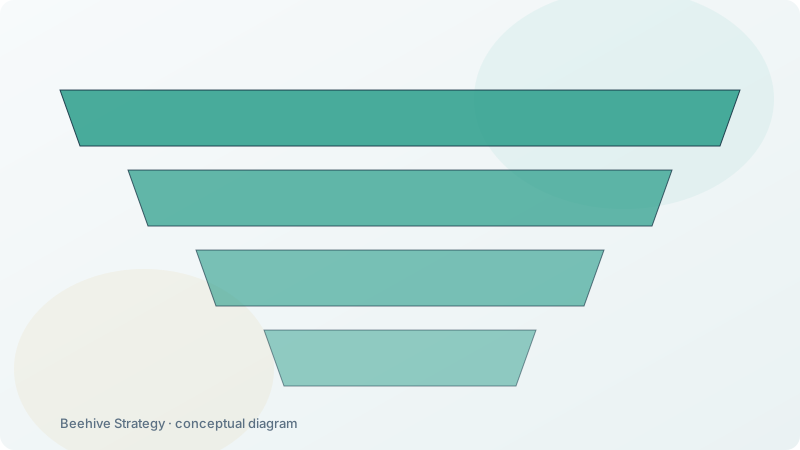
Production monitoring covers four domains, and a Q4-ready system covers all of them. The first is data drift detection: statistical tests on input distributions that flag when the model is being fed data unlike its training set. The second is performance monitoring: tracking accuracy, precision, and the business metric the model was built to move, computed against labels as they arrive. The third is concept drift: detecting when the relationship the model learned has changed, even if the inputs look normal. The fourth is operational health: latency, throughput, error rates, and the pipeline freshness that determines whether the model is deciding on current data at all.
Each domain answers a different failure question. Data drift says the world changed. Performance says the model is wrong. Concept drift says the model's logic is stale. Operational health says the model may not even be running as designed. Gartner has predicted that at least 30% of generative AI projects would be abandoned after proof of concept by the end of 2025 — and a large share of that abandonment traces to models that could not be trusted in production because monitoring was an afterthought.
The four domains are not optional layers to add later; they are the minimum definition of "in production." A model that is deployed but not monitored in all four domains is not in production — it is in the wild, and the difference becomes visible at the worst possible moment, which is usually Q4.
Key Benefits and ROI Considerations
The ROI of monitoring is measured in the cost of the failures it prevents. In Q4, the stakes are concentrated: a demand forecast that drifts unnoticed means stockouts or write-downs; a credit model that degrades means risk decisions made on stale logic; a pricing model that drifts means margin given away across the entire catalogue. The cost of one undetected drift event in peak season routinely exceeds the annual cost of a monitoring platform.
Monitoring also protects the model's licence to operate. A model that fails visibly and without warning erodes stakeholder trust in AI across the organisation — the kind of trust that takes years to rebuild. Teams with production monitoring can catch degradation early, retrain or re-weight on fresh data, and report the intervention to stakeholders with evidence. That transparency is what keeps production AI funded: enterprises that can show a model was caught and corrected are far more likely to get budget for the next one than those whose models fail silently.
The measurement discipline also compounds. Monitoring generates a running record of model behaviour that becomes the evidence base for future decisions — which models to scale, which to retire, which to retrain. Enterprises that monitor well stop arguing about AI value in the abstract and start pointing at the data. In budget season, that is the strongest possible position: the model that can prove it was reliable all year gets renewed; the one that was never measured gets questioned.
Implementation Roadmap and Next Steps
Standing up Q4-ready monitoring follows a sequence that starts before peak season. First, baseline: capture the current distribution and performance of every production model so drift has something to be measured against — most teams discover they have no baseline at all. Second, instrument: log inputs, predictions, features, and outcomes for every inference, which is the raw material for every drift and performance check. Third, alert: define thresholds and escalation paths for each domain so that drift triggers a response from a named owner, not a dashboard nobody reads. Fourth, close the loop: define the retraining trigger and rollback path so that when drift is detected, there is a rehearsed response.
The Q4-specific trap is treating monitoring as a technology project with a long lead time. A pragmatic monitoring setup — statistical drift checks, performance tracking against arriving labels, and operational alerts — can be deployed in weeks, not quarters, if it is built on the logs the systems already produce. The teams that succeed are those that start monitoring before they need it, because the first drift event is never announced in advance.
- Baseline every production model's current distribution and performance.
- Instrument inference logs — inputs, predictions, features, outcomes.
- Alert on all four domains with named owners and escalation paths.
- Define the retraining trigger and rollback path before you need them.
- Review drift reports weekly through Q4, not monthly.
What Should You Monitor This Quarter?
Start with the models whose failure would hurt most this quarter — the forecast, pricing, risk, or personalisation models whose errors convert directly into P&L impact. For each, confirm the four domains are covered, the baseline exists, and the alert has an owner. If any of those is missing, that is this quarter's project; if all exist, the project is rehearsing the response — because the drill is what makes monitoring valuable.
The data-side requirement deserves attention: monitoring is only as current as the data feeding it. Models that decide on live data need live data observability, and teams that deploy conversational analytics over streaming data find that the same infrastructure supports both real-time answers and real-time drift detection. Beehive Strategy runs this as a managed service — conversational BI over governed data, deployed in about two weeks, so enterprises get real-time answers and the visibility to trust them during the most important quarter of the year. Q4 is where production AI earns its keep; monitoring is how you know it did.
How Do You Detect Silent Model Failure Before Customers Do?
Silent failure is the dangerous kind: the model still returns answers, the dashboard is green, but the answers have quietly stopped being right. Detection means monitoring the things customers would notice if they could see them — output distribution shift, input drift, and a rising rate of human overrides — and treating any of them as a possible failure, not noise.
The discipline is to monitor leading signals, not lagging complaints. Enterprises that watch override rates and feature drift catch a degrading model weeks before a customer-churn spike makes it obvious, and they have time to retrain while the damage is still small and contained.
What Does a Production Monitoring Stack Look Like?
A monitoring stack is three layers: data monitoring for input quality and drift, model monitoring for performance and fairness, and business monitoring for the outcomes the model was meant to improve. They feed one alerting layer with clear ownership, so a signal from any layer reaches the right person without a manual daily check.
Crucially, the stack must be version-aware: when a model or its data changes, the baselines shift with it, so an alert means a real change, not a deployment artefact. Enterprises that build the version-aware stack avoid the boy-who-cried-wolf fatigue that makes teams ignore the alert that mattered.
How Should Alerts Reach the Right Owner Fast?
An alert nobody owns is just a log entry. The operating rule is that every monitored risk has a named owner and a defined response — acknowledge, investigate, or roll back — within a set time. The alert arrives where the owner already works, not in a dashboard they check weekly, so the loop closes in minutes, not in the next review.
The maturity signal is response time, not alert count. Enterprises that measure mean time to acknowledge and to remediate turn monitoring into a safety system; those that measure only how many alerts they sent are managing noise, and will miss the one that was real.
Which Monitoring Gaps Cause the Costliest Incidents?
The costliest incidents come from the gaps nobody instrumented: a third-party data feed that changed silently, a fairness metric no one tracked, a business outcome the model was supposed to move but no one watched. The model looked fine because the dangerous signal was never collected.
The remedy is to start monitoring from the harm, not from the metric. List what could go wrong, then ensure each has a sensor and an owner. Enterprises that close the harm-led gaps suffer fewer expensive surprises, because the failure they feared was already visible, and visible early enough to act.
What Should Teams Automate in Monitoring?
Automate everything that is a check, not a judgement: drift tests, threshold alerts, baseline updates on deploy, and the daily roll-up of health signals. The human's job is then the investigation and the decision, which no script should make alone. Automating the checks frees the scarce attention for the cases that actually need it.
The trap is automating the decision and leaving the human to rubber-stamp. We keep the automated layer as sensor and router, and reserve action — acknowledge, retrain, roll back — for a named owner on a clock. Teams that automate this way scale monitoring without scaling risk; those that automute the human scale blind spots.
How Do You Keep Monitoring Costs Low?
Monitoring costs creep when every model gets the same heavy surveillance regardless of harm. The lever is risk-tiering: expensive near-real-time monitoring on the few models that can hurt, lightweight checks on the many that cannot. Shared feature stores and a single alerting layer also avoid paying for the same sensor many times.
We also watch the cost of the monitoring itself as a line item, because a model that costs more to watch than to serve has failed the value test. Enterprises that tier and share keep monitoring affordable, and they can afford to watch the dangerous models closely — which is the entire point.
What Is the First Monitoring Step for a New Model?
The first step is not a dashboard; it is naming what could go wrong and assigning a sensor and an owner to each. Before a model serves real decisions, its failure modes are listed, baselines are set, and the alert routing is tested with a drill — so the first real incident is the hundredth time the path has run, not the first. Monitoring that starts with the harm, not the metric, is monitoring that works.
Why Is Monitoring a Team Sport, Not a Dashboard?
A dashboard watched by no one is theatre. Monitoring works only when the sensor, the owner, and the response are connected: the signal reaches a named person, who acknowledges, investigates, or rolls back on a clock. Treating monitoring as a shared responsibility with a clear escalation path — not a screen someone glances at weekly — is what turns data into safety and keeps the costliest incidents small.