Model Context Protocol (MCP) has become the default wiring of enterprise AI faster than almost any protocol in recent memory. In roughly two years it went from an Anthropic open-source proposal to a de facto standard adopted by OpenAI, Google, Microsoft, and thousands of tool builders — and in December 2025 it moved under the Linux Foundation's new Agentic AI Foundation, alongside goose and AGENTS.md, signaling that the industry intends it to be neutral infrastructure rather than any single vendor's property. For enterprises, the practical question has changed from "should we use MCP?" to "how quickly can we expose our systems through it?"
The scale numbers are the evidence. Anthropic reports MCP has passed 97 million installs, and the ecosystem now counts more than 1,000 community server implementations covering databases, SaaS applications, cloud services, and internal APIs (Anthropic and community ecosystem trackers, late 2025). Gartner's forecast that worldwide GenAI spending will reach $644 billion in 2025 (Gartner press release, October 2024) only makes the integration layer more valuable: when every model and every agent speaks one protocol, the marginal cost of connecting a new system collapses. This article explains why MCP won, what the Q4 2025 connector ecosystem looks like, and how to adopt it without inheriting a security headache.
Why Is MCP Becoming the Standard Interface Between Agents and Data?
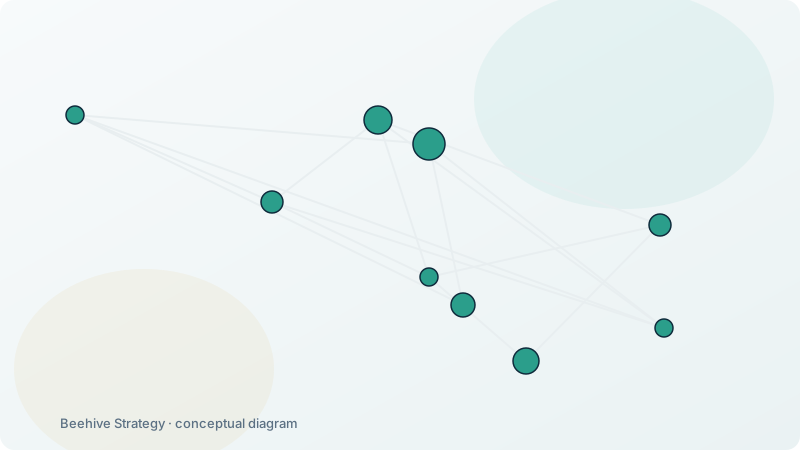
Answer-first: MCP won because it solves the last-mile problem that every enterprise AI project hits — getting a model to safely read and act on the systems where the business actually lives. Before MCP, every agent needed bespoke integrations: a custom connector for Salesforce, another for ServiceNow, another for the data warehouse, each with its own authentication, schema, and failure modes. The cost of that bespoke plumbing is precisely why so many AI pilots never leave the lab. MCP replaces N custom integrations with one protocol: the host (the agent or chat application) connects to MCP servers, and each server exposes the tools, resources, and prompts for one system.
The standard's momentum came from a rare combination of timing and sponsorship. Anthropic open-sourced MCP in late 2024; OpenAI adopted it in March 2025 and Google followed in April 2025, each folding it into their own agent platforms; Microsoft aligned its Copilot ecosystem around it through 2025. When every major model vendor supports the same protocol, the integration work an enterprise does once keeps working as models and platforms churn underneath it. That durability is the economic argument: integration code written against a single open standard outlives the model that motivated it.
The Linux Foundation move in December 2025 removed the last objection. With MCP governed neutrally rather than by a single vendor, enterprises can bet on the standard without betting on any one company's roadmap — the same dynamic that made Linux, Kubernetes, and OAuth safe choices in their eras. For buyers, this is the difference between adopting a product and adopting infrastructure.
How Broad Is the MCP Connector Ecosystem in Q4 2025?
Q4 2025 was the quarter the ecosystem stopped being a promise and became a catalog. Enterprise connectors now span categories that cover most of a modern data estate:
- Data platforms: warehouses, lakehouses, and query engines, so agents can answer questions against governed analytics data in real time.
- Business applications: CRM, ERP, service desk, HR, and marketing platforms, giving agents read and scoped write access to operational systems.
- Cloud services and storage: object stores, message queues, and cloud APIs, so pipelines and agents share the same plumbing.
- Internal APIs and knowledge bases: connectors for wikis, ticketing, and custom services that turn tribal knowledge into retrievable context.
- Collaboration surfaces: Slack, Teams, and other IM platforms, where conversational interfaces deliver answers to the place people already work.
Two developments made the Q4 expansion credible rather than cosmetic. First, the security model matured: the ecosystem moved from open-servers-anywhere to enterprise patterns with OAuth-based authentication, scoped permissions, server-side enforcement, and audit logging — the properties a CISO needs before an agent is allowed near customer data. Second, the connectors got opinionated about semantics rather than just plumbing: the best servers now expose not raw tables but named tools and resources — "get_active_customers_by_segment," "calculate_gross_margin" — which is what makes agent behavior predictable and, crucially, reviewable. A connector that exposes a business concept is worth ten that expose a table.
The business math follows. Teams that standardize on MCP-style connectors report cutting custom integration effort by 40-60% in mature deployments, because the marginal connection costs a fraction of the first one. More importantly, the same connector serves every consumer: a data scientist's notebook, a dashboard, and a chat-based conversational BI assistant can all reach the same governed endpoint. That is the pattern Beehive Strategy relies on for its managed conversational BI service — connect once through standard, secure connectors, and the answers in chat, Slack, or Teams are computed against the same definitions and permissions as every other tool in the estate.
What Are the Key Benefits and ROI Considerations?
The ROI case for MCP is an infrastructure case, which means it compounds. Direct savings come from integration labor: fewer bespoke connectors, fewer broken pipelines when APIs change, less duplicated authentication and transformation code. McKinsey Global Institute estimates generative AI could add $2.6 trillion to $4.4 trillion in annual value across 63 analyzed use cases (McKinsey, 2023), and the layer that determines whether any of that value is capturable is exactly the one MCP standardizes — getting models to the data. An IDC study sponsored by Microsoft found generative AI returning $3.70 per $1 invested with an average 14-month payback (IDC, October 2024), and the fastest-payback deployments are consistently the ones that did not have to build connectivity from scratch.
Risk management is the other half of the ledger, and it is where the security model matters. Granting agents access through MCP servers should follow least-privilege principles: scoped OAuth tokens, per-server permission sets, human approval for write operations, and full audit trails of every tool call. Gartner's warning that more than 40% of agentic AI projects will be canceled by the end of 2027 (Gartner press release, June 2025) is largely a warning about governance and integration debt, not model capability. Enterprises that adopt the protocol with a real access model — rather than pointing an agent at everything and hoping — are the ones that keep their deployments alive.
Finally, measure the architecture itself. Track connector count, integration cycle time, and time-to-answer for the questions your agents are supposed to handle, and report them alongside business outcomes. A connector ecosystem is not a project with an end date; it is a capability whose value shows up in every future deployment, which is exactly why the organizations moving fastest are treating it as shared infrastructure, funded and governed like a platform.
What Does an MCP Implementation Roadmap Look Like?
Adopting MCP does not require a big-bang migration. Phase one: inventory the five to ten systems your agents or conversational assistants most need — start with the data platform and the two or three operational systems with the most repetitive questions. Phase two: stand up MCP servers for those systems with proper authentication and scoping, and pilot one use case end-to-end, from chat question to governed answer. Phase three: expand the catalog as trust builds, add write-scoped tools only where approval workflows exist, and wire monitoring and audit logging into your existing security operations.
For teams that want the benefit without the build, a managed approach is increasingly available: conversational BI delivered as a service, deployed in about two weeks, with connectors, semantic definitions, permissions, and evaluation already maintained by the provider. The protocol is the reason that speed is possible — the integration work is done once, at scale, instead of once per customer. The decision framework is the same as for any platform bet: choose the standard that outlives vendors, secure it like production infrastructure, and let the ecosystem do the heavy lifting.
The window to standardize is now, while the ecosystem is still consolidating. Every connector you build or buy this year is infrastructure you will not have to rebuild when the next model generation arrives — and that is the quietest, most reliable ROI in enterprise AI today.
What Changes Now That MCP Is Neutral Infrastructure?
The move of MCP under the Linux Foundation's Agentic AI Foundation in December 2025 changed the risk calculus for enterprise adopters more than any feature release. While the protocol was associated primarily with one vendor, adopting it meant accepting a degree of platform dependency. Under neutral governance, with OpenAI, Google and Microsoft all supporting it and thousands of tool builders shipping servers, the protocol becomes infrastructure in the same category as HTTP or SQL: something you build on rather than something you bet on.
Three practical consequences follow. First, procurement risk falls — enterprises can require MCP support in vendor evaluations without implicitly choosing a platform. Second, internal build decisions get easier: an MCP server written for one assistant works with any compliant client, so integration work stops being stranded when a model or assistant changes. Third, the security conversation changes shape. A neutral protocol attracts scrutiny, and the enterprise question shifts from "whose protocol is this?" to the harder and more useful question of how tool access is authorised, scoped, and audited.
That last point deserves emphasis, because it is where most MCP deployments are weakest. A protocol that makes it easy to connect an agent to everything also makes it easy to connect an agent to too much. The governance requirement is a tool registry with explicit scoping: every server declares which resources and tools it exposes, every client declares which it may call, and the intersection is what the agent can actually reach — with every call logged.
How Do You Evaluate a Connector Before Trusting It?
Breadth of the catalogue is the least useful criterion. What matters is whether a specific connector behaves safely and predictably under the conditions your agents will actually create. Six checks separate production-grade connectors from demos.
- Authentication and scoping. Does it use OAuth or short-lived credentials rather than a shared service account, and can permissions be scoped per agent rather than per installation?
- Read/write boundaries. Are write tools clearly separated from read tools, so a read-only agent can be configured to be structurally incapable of writing?
- Pagination and limits. Does it handle large result sets properly, and does it enforce sensible limits rather than pulling an entire table into a prompt?
- Error semantics. Does it return structured, actionable errors — permission denied, rate limited, resource not found — rather than a generic failure the model will hallucinate around?
- Idempotency on writes. For any tool that creates or mutates, does it accept an idempotency key? This is the single most important property for tools that will be called by a retrying agent.
- Observability. Does it emit traces with the request, the tool, the arguments, and the outcome, so that a bad agent action can be reconstructed after the fact?
A connector that fails any of the first two should not be deployed in an enterprise context regardless of how useful it looks. A connector that fails the last three will work in testing and produce incidents in production.
What Does a First MCP Deployment Look Like?
The deployments that reach production share a shape: narrow scope, read-only first, one measurable workflow. The pattern that works:
- Pick the workflow by question volume, not by ambition. Find the five to ten questions your teams ask most often across the systems they ask them about. That set defines the first servers to build — usually the data platform plus two or three operational systems.
- Deploy read-only and measure. Stand up the servers with read tools only, wire them to one assistant, and run for four to six weeks. Track the share of questions answered without human escalation and the accuracy against a golden set. This phase proves value without creating risk.
- Add write tools behind approval. Introduce the first mutating tool — creating a ticket, updating a record — with human approval on every call, an idempotency key, and full tracing. Approve based on the error rate observed in the read-only phase.
- Scale by server, not by agent. Extend coverage by adding servers and tools to the same governed registry rather than by giving more agents unrestricted access. Centralising the registry is what keeps the audit surface tractable as the estate grows.
The measurable outcome to hold the programme to is not the number of connectors deployed. It is the reduction in integration maintenance effort and the share of questions answered end-to-end without a human in the loop. Those two numbers determine whether the connector investment compounds, and they are visible within the first quarter.