
Ask a modern BI engine "what were sales by region last quarter?" and behind the scenes an extraordinary pipeline is at work: your question is parsed, mapped to the data, translated into SQL, executed, and returned as an answer in seconds. Natural language to SQL is the technology that makes conversational analytics possible, and in 2026 it has matured from a demo trick into a production capability. This article explains how these engines actually work — the components, the failure modes, and what separates trustworthy systems from impressive demos.
What Does the Current NL2SQL Landscape Look Like?
The demand is easy to understand. For decades, the bottleneck in analytics was not data — it was the skills needed to query it. Gartner has estimated that fewer than 25–30% of employees in a typical enterprise can write SQL or use BI tools effectively, which means most business questions either wait for analysts or never get asked. Natural language to SQL attacks this bottleneck directly, and the 2024–2026 period has seen the technology move from research novelty to an embedded feature in most major BI platforms.
The accuracy conversation has also matured. Early demos generated SQL that was impressive and often wrong; production systems hold themselves to a different standard. Industry benchmarks like Spider and BIRD measure text-to-SQL accuracy in controlled settings, and modern systems claim 80–90% or higher on standard benchmarks — but enterprises quickly learn that benchmark accuracy is not production accuracy. The real work is in the enterprise-specific layers: the semantic model, the context, and the guardrails around query generation.
How Does an Engine Turn a Question into SQL?
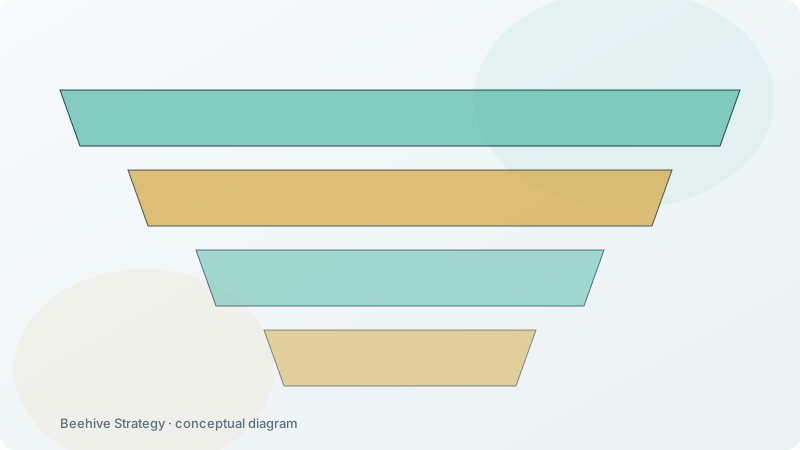
It helps to walk through the pipeline, because the architecture explains both the strengths and the failure modes. The first stage is intent understanding: the engine parses the question, resolves entities ("sales" means the revenue fact table, "region" means the region dimension), and maps them to the semantic layer — the business-friendly definitions of metrics and dimensions the organisation has agreed on. This is why a semantic layer is not optional decoration; it is the translator that lets the engine know that "profit" means gross profit after allocated costs, not EBITDA.
The second stage is query construction: the engine generates SQL against the physical schema, choosing joins, aggregations, filters, and time windows. Modern engines combine large language models with programmatic templates and validation passes — generating candidate SQL, executing it against a sandbox or sample, and checking the results against the user's expectations. The third stage is explanation and iteration: the engine presents the answer, the SQL behind it, or a natural-language paraphrase, so the user can verify the result and refine the question. That verification loop is what turns a guess into a decision.
There is a fourth stage that separates production systems from demos: feedback and learning. Every query, every correction, and every abandoned follow-up becomes signal. When a user rephrases a question because the first answer missed the intent, the engine learns the vocabulary; when a query times out or returns an empty result, the operations team learns what to cache and precompute. Modern engines are continuously evaluated — answer accuracy sampled against known-correct results, user satisfaction tracked per domain — and the best-run deployments treat those metrics as product requirements rather than research curiosities. The engine improves not only because the underlying model updates, but because the system around it records and acts on what users reveal.
What Are the Key Implementation Challenges for NL2SQL?
The first challenge is ambiguity. Human language is imprecise, and business language is worse. "Show me margins by month" could mean calendar month or fiscal month; "sales" could mean booked, invoiced, or recognised revenue. Without a governed semantic layer that resolves these definitions, the engine is guessing — and confident guessing is more dangerous than honest uncertainty. Enterprises that skip the semantic layer get demos that impress and answers that mislead.
The second challenge is trust and verification. Users need to know whether an answer is exact or approximate, current or cached, and derived from the data they think it is. Modern engines address this with transparency features — showing the generated query, the data sources, and the freshness — but organisations must design for this trust-building rather than assuming it. Research on conversational BI adoption shows that users' willingness to act on an answer depends less on model accuracy and more on their ability to verify it.
The third challenge is security and governance. A natural language interface is a query surface, and it must respect row-level security, permissions, and data policies. The most dangerous failure is not an engine that misinterprets a question — it is one that correctly answers a question the user should not be allowed to ask. Production systems enforce governance at the semantic layer, so the model never sees tables the user cannot access.
Which Practical Approaches Actually Work?
The organisations that get value from natural language to SQL treat the semantic layer as the product. They invest in defining metrics, dimensions, and synonyms — the vocabulary of the business — and they maintain it as the business evolves. They also curate the context the engine needs: time zones, currency conventions, fiscal calendars, and the definitions that matter to the specific users of each domain.
Second, they manage expectations with transparency. Production systems at Beehive Strategy and elsewhere present the reasoning behind an answer: the paraphrase of the user's question, the semantic path used, and the ability to drill down. Users who can verify an answer adopt the tool; users who cannot revert to spreadsheets. We consistently see that deployments with explicit verification features reach self-service adoption rates of 60–80% of business users, while opaque systems plateau at 20–30%.
Third, they design for iteration. The first question a user asks is rarely the right one; the value is in the follow-up. "Why did the North region drop?" leads to "which customers?" leads to "what changed last month?" Engines that support multi-turn conversation and remember context within a session multiply the value of every question, because each answer positions the next question. This is the difference between a search box and a conversational analyst.
What Should You Look For in a Modern BI Engine?
When evaluating a natural-language BI engine, the criteria have shifted from "can it generate SQL?" to "can it be trusted in production?" A short checklist helps: does it enforce governance at the semantic layer? Can users verify and interrogate answers? Does it handle ambiguous business language with defined metrics rather than guesses? Does it support multi-turn conversation? And can it be measured — do you know your answer accuracy and adoption rates, or are you flying blind?
The evaluation checklist:
- Verify that queries are governed at the semantic layer, with row-level security enforced end to end.
- Confirm the engine shows its reasoning — paraphrased question, generated query, data sources, and freshness.
- Test ambiguous business language: "margins by month" should resolve to defined metrics, not guesses.
- Check multi-turn capability: follow-up questions should build on context within a session.
- Measure answer accuracy and adoption in production — benchmark results are not production results.
Key Takeaways
- NL2SQL engines work through three stages — intent understanding, query construction, and verification — all anchored by the semantic layer.
- The semantic layer, not the model, is what makes answers trustworthy in production.
- Ambiguity, verification, and governance are the three failure modes that sink demos-turned-products.
- Transparency and multi-turn conversation drive adoption: 60–80% of users go self-service with them.
- Evaluate production accuracy and governance, not benchmark scores.
Conclusion
Natural language to SQL is the interface that finally lets the whole organisation — not just the data-literate few — ask questions of their data. The technology works, but only when it is built on a governed semantic layer, transparent reasoning, and a design for iteration. At Beehive Strategy, we build conversational analytics on exactly these foundations, so that business users across Asia-Pacific enterprises can interrogate their data in natural language with answers they can verify and trust. The question is not whether your organisation will adopt natural language BI; it is whether it will adopt it with the governance that makes it reliable.
What Does a Natural-Language Query Actually Touch in the Stack?
When a user types a question, the engine does not simply emit SQL against your raw warehouse. A mature pipeline first parses intent, then maps the natural-language terms to concepts in the semantic layer, resolves which metrics and dimensions those concepts imply, and only then generates a query against governed views rather than base tables. This indirection is the whole game: the model is insulated from schema minutiae and forced to use the company's approved definitions. The result is that "revenue" means the same thing in every answer, even if twelve tables are involved underneath.
Why Does the Semantic Layer Decide Whether NL2SQL Works?
The semantic layer is the contract between human language and database structure. It declares that "active customer" equals a specific filtered cohort, that "gross margin" uses a particular cost allocation, and that "this quarter" resolves to locked fiscal boundaries. Without that contract, the model guesses, and guessing is where confident, wrong answers come from. Organizations that invest in the semantic layer first — before they ever evaluate a model — are the ones that reach production reliably. Those that buy the model first and hope the definitions sort themselves out almost never do.
What Are the Failure Modes — and How Do You Handle Them?
The most damaging failure is silent hallucination: a query that runs, returns numbers, and is simply wrong because a join was invented. Mitigations are practical. Constrain generation to the semantic layer so the model cannot reference tables outside the approved set. Add a confidence score and route low-confidence questions to a human confirmation step. Log every generated query with the definitions used, so a wrong answer is reconstructable after the fact. And keep a feedback loop: when a user corrects an answer, that correction sharpens the semantic layer for everyone.
How Should You Evaluate a Modern BI Engine Before Buying?
Do not be seduced by a vendor demo on their own clean dataset. Bring your own hardest questions — the ambiguous ones, the cross-domain ones, the ones where two teams disagree on the definition. Score the engine on resolution accuracy, on whether it uses your semantic layer rather than raw tables, on explainability (can it show the query and definitions?), and on governance fit (access control, audit log, human-in-the-loop). The right engine is the one that stays accurate on your messiness, not the one that looks magical on a slide.
Where Does NL2SQL Fit With Conversational BI?
NL2SQL is the query-generation substrate; conversational BI is the experience on top. The engine turns a question into a safe, governed query; the conversational layer turns the answer into a dialogue — follow-ups, charts, and the ability to ask "why" and get a drilled-down explanation. Enterprises should treat them as one stack: a semantic layer at the bottom, an NL2SQL engine in the middle, and a conversational interface at the top. Skip any one layer and the whole thing either drifts out of governance or fails to reach the business user.
What Implementation Patterns Make NL2SQL Trustworthy?
The trustworthy pattern is constraint, not freedom. The engine should generate against the semantic layer, never raw tables; it should return the generated query alongside the answer so a skeptical analyst can verify; it should expose its confidence and route low-confidence questions to a human; and it should log every query with the definitions used. Organizations that adopt all four treat the engine as a junior analyst whose work is reviewed, not as an oracle whose output is trusted blindly. That framing is what lets NL2SQL reach production instead of stalling in a proof of concept.
How Do You Pilot NL2SQL Safely?
Start in a read-only, high-trust corner of the business — a team that already trusts its semantic layer and asks repetitive questions. Let the engine answer, but require a human to confirm the generated query before it runs against production for the first few weeks. Capture every correction as a semantic-layer improvement, and only loosen the human-in-the-loop once accuracy on that team's questions is demonstrably high. A safe pilot is boring on purpose: narrow scope, visible guardrails, and a clear exit if the numbers do not hold up.


