A vector database is the retrieval engine behind modern AI search — the component that lets enterprise systems find content by meaning rather than by keyword. From retrieval-augmented generation (RAG) chatbots to semantic document search and product recommendations, vector databases index data as high-dimensional embeddings and answer queries by mathematical similarity, typically returning results in under 10 milliseconds even at billions of vectors. This article explains what vector databases are, how they work, when your enterprise genuinely needs one, and how they fit into a governed AI architecture.
What Is a Vector Database?
A vector database is a specialized database designed to store, index, and query high-dimensional numerical vectors — called embeddings — that represent data such as text, images, audio, or other content. Unlike traditional databases that search by exact matches or keywords, vector databases find the most similar items using mathematical distance metrics such as cosine similarity, enabling semantic understanding and similarity search. Two documents can share no keywords at all and still be retrieved as highly similar because their meanings are close in embedding space.
Vector databases are the backbone technology for RAG systems, recommendation engines, semantic search, and any AI application that needs to find relevant content by meaning rather than by string matching. The embedding models that power them — from OpenAI's text-embedding family to open-source alternatives — typically produce vectors of 768 to more than 3,000 dimensions, and enterprise indexes routinely grow past 100 million vectors as organizations embed their full corpus of documents, policies, and knowledge. Managing similarity search at that scale is exactly what a vector database is built to do.
How Does a Vector Database Work?
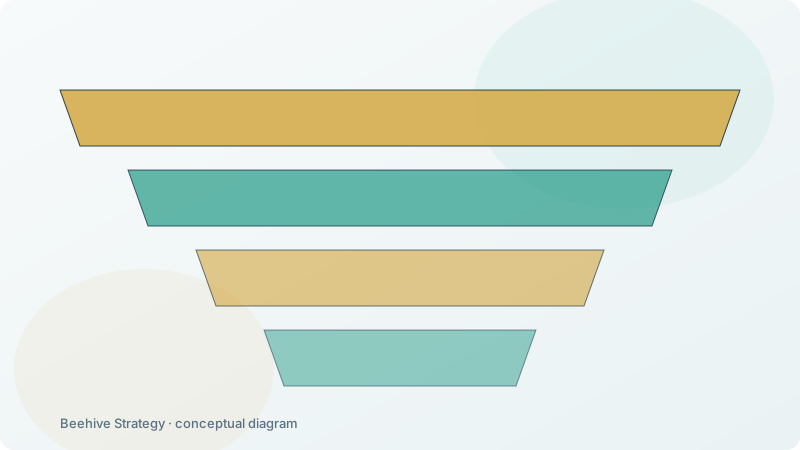
The pipeline has four stages. First, embedding generation converts content into high-dimensional vectors using an embedding model; semantically similar content lands close together in the vector space. Second, storage and indexing organize those vectors with specialized algorithms — HNSW and IVF being the most common — that trade small amounts of recall for massive retrieval speed. Third, similarity search embeds the query and finds its nearest neighbours using distance metrics. Fourth, metadata filtering combines semantic similarity with structured filtering, so a search can be limited to a department, a date range, or a document type.
- Embedding generation. Content is converted into high-dimensional vectors using embedding models such as OpenAI, Cohere, or open-source alternatives.
- Storage and indexing. Vectors are stored with their metadata using indexing algorithms such as HNSW and IVF for fast retrieval at scale.
- Similarity search. The query is embedded and nearest neighbours are found using cosine similarity or Euclidean distance.
- Metadata filtering. Results are filtered by attributes, combining semantic similarity with structured constraints.
Popular Vector Databases
The ecosystem is mature and diverse. Managed services such as Pinecone, Zilliz Cloud, and Weaviate Cloud remove operational burden for teams that want to focus on application logic. Open-source options — Weaviate, Milvus, Qdrant, and Chroma — give organizations full control and no per-query fees, at the cost of running their own infrastructure. And extensions such as pgvector for PostgreSQL and Atlas Vector Search for MongoDB let teams add vector search to databases they already operate, avoiding a new system entirely when the workload is modest.
- Managed services: Pinecone, Zilliz Cloud, Weaviate Cloud for operational simplicity.
- Open-source options: Weaviate, Milvus, Qdrant, Chroma for control and portability.
- Database extensions: pgvector (PostgreSQL) and Atlas Vector Search (MongoDB) for embedding vector search in existing systems.
Why Enterprises Need Vector Databases
Enterprise use cases for vector databases fall into four categories. AI-powered search finds documents, products, and answers by meaning, transforming how employees locate policies, research, and tribal knowledge. RAG infrastructure is the most consequential: retrieval-augmented generation systems ground large language model answers in the organization's own verified content, and Gartner projects that more than 30% of enterprise search will be vector-based by 2027. Recommendation engines use similarity at scale to suggest content and products. And multi-modal search finds similar images, audio, or video from embeddings, opening use cases from visual quality control to media asset management.
The enterprise value is compounding. Vector search is not a replacement for keyword search — the best systems blend both — but it is the layer that makes AI systems safe to trust with internal knowledge, because it decides what the model is allowed to answer from. A RAG system is only as reliable as its retrieval, and retrieval at enterprise scale is a vector database problem.
Beehive Strategy and Vector Databases
Beehive Strategy uses vector databases within our RAG and semantic search infrastructure. When users ask questions through our conversational BI platform, relevant documentation and business context are retrieved from our vector index to ground AI responses in verified, contextual information — so answers about metrics, definitions, and platform usage are anchored in the organization's own corpus rather than generated from thin air.
Vector retrieval and the semantic layer work together in our architecture: the semantic layer governs which data and metrics a question may touch, while vector search supplies the contextual grounding that makes responses precise and explainable. The result is conversational BI that is both accurate and auditable — retrieval-enhanced rather than purely generative.
When Does Your Enterprise Actually Need a Vector Database?
You need a vector database when your AI ambitions depend on retrieving the right content at scale: a RAG assistant that must answer from a large policy library, semantic search over hundreds of thousands of documents, or recommendations computed from millions of items. At modest volumes — a few thousand documents and low query rates — a database extension such as pgvector is usually sufficient, and starting there is a sensible way to validate the use case before committing to a dedicated system.
You should move to a dedicated vector database when scale, latency, or feature depth demands it: indexes past roughly ten million vectors, sub-10 millisecond query requirements, hybrid search that fuses keyword and vector retrieval, or multi-tenancy and security features that database extensions do not provide. The practical rule is to let the workload dictate the choice, piloting on the simplest adequate option and upgrading when the evidence — not the roadmap — says you have outgrown it. Either way, the decision should be revisited at least annually, because both the workloads and the tools are evolving quickly.
Key Considerations for Implementation
When implementing vector search, organizations should carefully evaluate their existing infrastructure, team capabilities, and long-term strategic objectives. A phased rollout is recommended, starting with a well-defined pilot — one corpus, one set of questions, one measurable accuracy target — that demonstrates clear business value before scaling across the enterprise. Key success factors include executive sponsorship, cross-functional collaboration between data, engineering, and the business teams whose knowledge is being indexed, and a robust change management programme that trains users on what semantic search can and cannot do.
Measuring the impact requires establishing baseline metrics before deployment — retrieval latency, answer accuracy, and the rate of queries that end in user frustration — and tracking progress against clearly defined KPIs. Common metrics include query response times, retrieval precision and recall, user adoption rates, accuracy of generated answers, and reduction in time spent hunting for information. Regular retrospectives and iterative improvements — re-embedding content as models improve, curating the corpus, tuning similarity thresholds — ensure the system continues to deliver value as business needs evolve.
Beehive Strategy Comprehensive Approach
Beehive Strategy delivers enterprise-grade AI and data analytics solutions built on MCP connectors and a robust semantic layer. Our platform lets executives, analysts, and business users query live data through natural language interfaces with full governance and auditability, grounded by vector retrieval over the organization's own knowledge. Whether you are exploring conversational BI for the first time or scaling an existing analytics platform, our team provides the expertise and technology to ensure success at every stage of your data transformation journey.
How Do You Keep Vector Search Accurate as Content Changes?
A vector index is only as trustworthy as the content behind it, and enterprise corpora change constantly — policies are revised, products are discontinued, support articles go stale. The most common failure is a one-time embedding pass: content is vectorized at launch and never refreshed, so the index silently drifts from reality and the RAG answers it grounds become confidently wrong. The fix is treating embedding as a pipeline, not an event. Re-embed documents when they change, expire vectors for deleted content, and version your embedding model so you can re-index the whole corpus when a better model ships. Many teams schedule a full re-embed quarterly and incremental updates continuously, then measure answer accuracy to catch drift before users do.
Corpus curation matters as much as freshness. Vector search retrieves by similarity, so near-duplicate, low-quality, or contradictory chunks compete with the right answer and dilute precision. Prune boilerplate, deduplicate, and chunk deliberately — too large and you lose specificity, too small and you lose context. Store the source and a timestamp with every vector so an answer can cite its provenance, which is what makes retrieval auditable rather than a black box. The teams that get reliable RAG are the ones who manage their vector corpus like a living library, not a dump.
How Do You Secure and Govern a Vector Database?
Vectors feel abstract, but they are sensitive. An embedding of a confidential document can leak its meaning to anyone with query access, and a poorly scoped RAG system can surface salary data to an intern. Governance starts with the same controls you would apply to the source data: namespace or partition vectors by sensitivity, enforce row- and tenant-level access at query time, and keep the semantic layer as the gatekeeper that decides which collections a question may touch. Encrypt vectors at rest and in transit, and log every retrieval so you can prove what the AI was allowed to read.
Multi-tenancy deserves special care. If you serve several business units or customers from one index, isolation must be enforced in the query path, not assumed from application logic — a metadata filter that can be bypassed is not security. Prefer engines that support per-namespace keys and verified access policies. Finally, watch for extraction risk: an attacker who can query the index with crafted prompts may reconstruct stored content, so rate-limit and monitor query patterns the way you would any data store. A vector database is a database; govern it like one, and it scales your AI safely rather than quietly leaking your enterprise's knowledge.
What Does a Production Vector Search Architecture Look Like?
For most enterprises the right shape is a retrieval tier in front of the model, not a vector database bolted on after the fact. Content flows from source systems into an embedding pipeline, lands in a managed or self-hosted vector store, and is queried by the RAG layer that fuses semantic similarity with keyword and metadata filters — hybrid search routinely beats either method alone. The model itself never sees the raw corpus; it receives only the retrieved, permissioned passages, which is what keeps answers grounded and containable. In Beehive Strategy's architecture the semantic layer supplies the access rules while vector search supplies the grounding, so a question is answered from verified, in-scope content every time.
Operationally, separate the write path from the read path. Ingestion can be batched and asynchronous; queries must be fast and highly available. Put a cache in front of repeated questions, monitor recall and latency per collection, and keep a human-in-the-loop escape hatch for low-confidence answers. Start on the simplest option that meets the workload — pgvector for modest corpora, a dedicated engine past ten million vectors — and let evidence drive the upgrade. That disciplined path is how vector search moves from a demo to dependable enterprise infrastructure.
How Much Does a Vector Database Cost in Practice?
Cost is rarely the embedding storage itself; it is the query volume and the infrastructure to serve it. Managed services charge per operation and node hour, which is predictable at small scale and can surprise you at high scale — a customer-support assistant fielding millions of queries a month accrues real retrieval spend. Self-hosting removes per-query fees but adds engineering time for clustering, upgrades, and uptime. The honest budgeting move is to model cost against query volume from day one: estimate queries per month, price both managed and self-hosted at that volume, and pick the option whose total cost of ownership stays below the value of the time and errors it saves. For most enterprises the retrieval cost is a rounding error against the labour of manual search it replaces — but only if you size it against real usage rather than a vendor's default tier.